Showing posts with label race relations. Show all posts

Sunday, March 31, 2013

21st Meeting: Same Kind of Different As Me

Wow, I am very far behind in blogging about book club meetings. Four meetings behind, actually. Totally unacceptable, right? What if I give you a sob story about how I've been working on my dissertation and haven't had time to use any energy writing about anything but construal level and social comparison (trust me, it's interesting... or not). You're right. No excuse!

Without further adieu, let's get back into the swing of things with talking about the 21st meeting of Eat, Drink, and Be Literary. Way back in November, Sarah hosted and picked the book Same Kind of Different as Me: A Modern Day Slave, an International Art Dealer, and the Unlikely Woman who Bound Them Together, by Ron Hall, Denver Moore, and Lynn Vincent. She picked the book because it was on some New York Times "best of" list, and because she is a fan of memoir/ non fiction. The rest of us were skeptical to say the least when we found out what book was picked. The book not only fits into the genre of memoir, but also into the genre of Christian writing, and somehow this was a red flag for everyone. While some of the book club members, myself included, are Christians, the religious works we typically read are more academic or philosophical (think C.S. Lewis) or more veiled in symbolism (think The Giving Tree.) An overtly "Jesus saves" book just didn't sound too appealing.
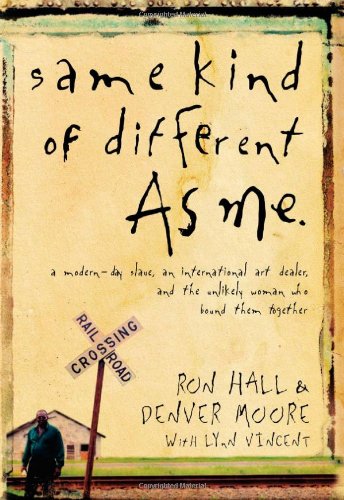


When the book club meeting began, we were all very surprised to admit that we almost kind of liked the book, or at the very least, we didn't hate it. The book follows the lives of two men-- one poor black man named Denver, who lived as a modern day slave and ended up homeless in Dallas, and one very wealthy white man named Ron who with his wife, began volunteering at the shelter and soup kitchen where Denver spent time. The two men became close friends, and helped each other to grow in a really beautiful way.

Typically, both the first and last question we ask at book club is "did you like it?" Usually, everyone's approval rating increases from the beginning of the meeting to the end, but this time it was different. Instead, the more we talked about the book, the less we liked it.  I think we all just felt that the truly special part of the story was Denver's life, and we felt that the book maybe spent too much time focusing on Ron's life instead. Obviously Ron was writing his portion of the book as a way to reflect on how much growth he'd had since Denver came into his life, and as a way to heal from the loss of his wife (oh yeah, spoiler alert, his really wonderful wife dies of cancer and I might have cried a little), but after awhile, it started to come across as self-indulgent. It's hard for me to say, because I know that everyone has a story worth telling-- especially when that story is about making themselves better, but we just didn't find Ron's story as compelling as Denver's.


Thursday, June 7, 2012

Mudbound


Well, I am officially two book club meetings and approximately 6 books behind in blogging. I am going to blame a combination of things including deadlines for writing manuscripts at work and beautiful sunny weather for the last several months. How is a girl to get anything done? Sheesh.

Anyway, my review of Mudbound by Hillary Jordan is a long time coming. My mom originally ordered this book for me close to a year ago after she read and loved it. After Amazon managed to send it to my college apartment (which I have not lived in for over 7 years now) not once but TWICE, a copy finally found its way to me in good old Coralville. I really hope the Loyola student who got the book in Chicago enjoyed it, that's all I can say! Maybe they gave the second copy to a friend...

I read this book at the same time as Wise Blood, and as I've previously mentioned, I managed to get confused on the names quite a bit. But, looking back at the two books, I realized they have much more in common than two syllable titles. Both novels take place in the south post WWII, both deal with soldiers struggling to understand life upon their return, and both have plenty of racial tension. 


Mudbound was a much easier read than Wise Blood, in my opinion, and perhaps more emotional. Whereas Flannery O'Connor made me think and scrutinize and look for symbolism in Wise Blood, Hillary Jordan pretty much spelled every emotion out for me in Mudbound... and I'm not sure if that is good or bad.

Mudbound is one story told from the point of view of multiple narrators, and comes across at times like a collection of short stories. I've read numerous books of this format lately  and while I really enjoy it, I'm also wondering if it is being over done. Mudbound is mostly told from the point of view of Laura, a city girl who finds herself living on a remote and rustic farm with her husband, children, despicable father-in-law, and the Jacksons a family of black sharecroppers. When Laura's brother-in-law, and the Jacksons' son return from WWII, they become unlikely friends. Throughout the book, there are chapters from every character's perspective, and Jordan really manages to bring the emotions and racial tensions of the time. I enjoyed the book a lot, and would definitely recommend it as an easy summer read.

Sunday, November 6, 2011

Eleventh Meeting: The Immortal Life of Henrietta Lacks

So, as it turns out, working on my prospectus, grading papers, and having ever Saturday designated for tailgating and football not only makes me neglect blogging, but reading in general. For the past three months, I have only had time to read book club books (usually I read at least one book on the side each month too). And, I am two meetings behind in my blogging! Well, that all changes now.

September's meeting was hosted by my besty Lisa. She picked Rebecca's Skloot's The Immortal Life of Henrietta Lacks.  The story of Henrietta Lacks is an unusual one-- as a woman, hardly anything is known about her, but her contribution to science is infamous! Henrietta was a poor black woman living outside of Baltimore in the 1950's. When she was diagnosed with ovarian cancer, her doctors took some of her cancer cells without the knowledge or consent of her family. These cells, known as HeLa cells, were the first human cells ever able to be cultured, and they revolutionized the way we research and understand cancer and living cells in general. The book is part biography of Henrietta, part biography of HeLa, part scientific journalism, part memoir of the author uncovering this story, and reads like a novel. I found it to be incredible.

The book raises a lot of issues from racism to medical ethics to justice. Why were the HeLa cells taken without consent? Why was her family never told about the cells? How could Henrietta's cells be so influential in the face of health care today while her children can't even afford a doctor's visit? While it would be easy to point fingers and paint certain parties as villains in this book, I think that Skloot did a great job of reporting objectively, with no judgment, the role of each family member or physician.

As usual, the review of Eat, Drink, and Be Literary were mixed. While most of the book club members are psychologists, we have our fair share of experience with ethics and ethical violations, so some parties thought the book was just exploiting another example of why there are so many ethical codes now. It was really interesting to hear Lisa's point of view as a health care professional, and also to hear our friend Mandy's point of view as a biologist. Mandy works with HeLa cells and could give us the inside scoop on how prevalent they are in labs worldwide, and how much they now cost to purchase. I loved the book, and hearing everyone's points of view I loved it even more!


Sunday, September 11, 2011

The Help

Remember how a few entries ago I mentioned something about never reading books until they had already come out as movies? Well, with this last novel I came in right at the buzzer. I finished The Help merely days before the movie premiered nationwide.

The HelpWow, what a book! I honestly had no idea what the book was about when I heard the buzz about it last year. It wasn't until I saw a preview for the film that I had any idea. The previews looked fantastic and I vowed I would read the book before heading to the theaters. I bought the book when my besty Lisa and I made one last nostalgic trip to the Borders in our home town during its going out of business sale and knew I had only two weeks to finish it... luckily this self-imposed challenge was incredibly easy to complete. The Help was engaging, powerful, and a feel-good story (my favorite) about a group of black women in Jackson, Mississippi in the 1960's and the white women they worked for. Stockett captured the complexity of a time where civil rights were making headlines but not making headway in homes of the south. The book showed that beneath the racial tensions that women are just women-- they face the same struggles, joys, and heartbreaks no matter what their skin color or place in life.

My favorite line in the book (which I highlighted and dog-eared) was apparently Kathryn Stockett's as well. As I read her afterword entitled "Too Little, Too Late", she said, "Washing that the point of the book? For women to realize, We are just two people. Not that much separates us. Not nearly as much as I'd thought."

This special book is the kind that stays with you after you read it. It was difficult to put back on the shelf.

**I haven't seen the movie yet, so this post will likely be updated once I do