Showing posts with label science fiction. Show all posts

Friday, January 4, 2013

20th Meeting: The Lathe of Heaven


After reading Ray Bradbury for our 19th book club, Mandy was inspired to choose another old school sci-fi book for our 20th meeting. She selected The Lathe of Heaven by Ursula K. Le Guin (1971).

It seems that sci-fi is a good genre for our reading group, as the book received a pretty warm reception overall. The story follows a man named George Orr who realizes that his dreams are literally coming true. If he dreams about a horse running in a field, he wakes up to see a painting change from a mountain to a horse; if he dreams there was a plague that wiped out half of the population, when he wakes up, reality confirms that it's true. When Orr visits a psychiatrist, Dr. Haber, he is hoping to put an end to his "effective" dreams, but the doctor tries to wield Orr's powers and use them for his own good by giving Orr things to dream about.

While reading the book, I kept thinking to myself "I've heard this story before" in some form or another (e.g., Inception anyone?) but when I reminded myself that this story came first -- in 1971-- I was blown away with the genius of it all.

This is the type of book that all of the Eat, Drink, and Literarians wanted to read again after discussing it so we could re-discover the symbolism, foreshadowing, and brilliance of Le Guin.


Sunday, August 12, 2012

19th Meeting: The Illustrated Man

I like to think that organizing a book club and writing a blog about the books I read means that I am a well-read person. But it's mostly a lie. I read every night, yes, but I don't read the books that I "should" read. You know, the books that everyone else has read? I guess you could also call them "classics". Ha! Anyway, I am mostly in denial about this because of all of the other signs that point to me being a prolific consumer of literature, but every so often, I can't escape the fact that I'm a fraud. For example, when one of the book club members selects a collection of short stories by Ray Bradbury.

everyone else in the world: "Oh, this book will be great! Fahrenheit 451 was so amazing, I bet this will  be wonderful too."
me: ... *crickets chirping*... "yeah, totally."
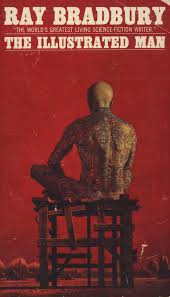
I mean, obviously, I've heard of Fahrenheit 451, I just haven't, you know... read it. But that doesn't mean I couldn't enjoy this month's book selection The Illustrated Man. Collections of short stories are almost always a hit at book club, because there's always enough variety that people find at least one story they connect with. This book was no exception- in fact, we unanimously liked the book!

The short stories in this book are all futuristic (though many take place in the 1980's or now-- they were all written in the 1950's) takes on technology and human nature. The stories either were about the end of the world through atomic warfare (something constantly present in the collective thoughts of the 1950's), or they were about a different life for people once space travel and "rocket men" were everywhere. While these specific events are not true of the future (at least yet) something Bradbury got right was the state of human nature. Bradbury captured the complexity of human character so perfectly-- while the potential for things like love and happiness exist in all of us, so do things like hate, fear, anger, and entitlement. Bradbury showed how consumerism and technology would be enough to corrupt us; while he was talking about rockets and not ipods, I'm not sure we are too far off his predictions of the world!

The short stories in this book were all tied together by the story of the illustrated man. This man was covered in magical tattoos that all moved and told stories, supposedly of the future. Each of the stories in the book was then supposedly one of the tattoos. I really liked this as a tool to tie the stories together. And in fact, the prologue and epilogue were some of my favorite parts of the whole collection! All in all, I thought this was a great book. After a fantastic discussion of this and Bradbury's other works, I may actually try to read Fahrenheit 451 one of these days!

*A final note. There are many editions of this book, and between the six people at our meeting, we had four different versions that didn't always include the same stories. Only one or two stories were different between the versions, but until we discovered that, our discussions were pretty bizarre (e.g., "You don't remember that story? But it was one of the best!)

Sunday, December 4, 2011

Thirteenth Meeting: Cloud Atlas

In December, Aaron hosted the thirteenth meeting of Eat, Drink, and Be Literary. For me, it seemed like "unlucky 13" because I did not particularly enjoy his pick Cloud Atlas, by David Mitchell. The book consisted of six short stories that wove through time and space. The book itself was like a palindrome-- the first story ended abruptly (I'm talking mid-sentence) about half way through and didn't continue until the very end of the book. In other words, it was both the first and last story, and the second was also the second-to-last.

Each story was told from the point of view of a wildly different character. First up was Adam Ewing, a sailor exploring New Zealand in the 19th century, next was Robert Frobisher, a pompous young composer in the early 20th century living in Belgium; third was Louisa Rey, a young woman living in the 1970's in California, fourth was Timothy Cavendish, a book publisher in what seemed to be present day England, fifth was Son-Mi, a clone turned revolutionary in a futuristic Korea, and finally was Zachry living in post-apocalyptic Hawaii. Each character seemed to be reincarnations of the previous character, and also read or watched the same short stories as we read.

If nothing else, I was incredibly impressed by Mitchell's abilities to write from the point of view of these wildly different people. However, it was mostly lost on me. I especially couldn't read the sections told in dialects (Zachry's in particular). I found myself turning pages without knowing at all what I was reading. The book club meeting definitely helped me appreciate the book more, and I left feeling like I should re-read the book. (I'm not going to, mind you, but I think I should).

As usual, the book had a mixed review among the group. Of eight or so people that came, I think half liked it, and half didn't... though most of us were probably hovering towards the neutral feeling. I will not be recommending this book to anyone anytime soon, unless they are a philosopher or really into thinking hard and not understanding anything... but again, I have to hand it to David Mitchell for writing such an incredible book. I feel bad that most of it was lost on me.

* This novel is being adapted into a film sometime soon, and has an incredible cast. I'm definitely going to check it out, and maybe (hopefully!) I will get more out of it.

Sunday, September 11, 2011

The Hunger Games Series

The Hunger GamesOh. My. Gosh. That is really all I can say.

I finished the Hunger Games series over two months ago and I have just been contemplating what to write about them ever since. Nothing I can say could ever accurately represent these novels or how much I loved them. This series was like brain candy. I read all three books in a combined four sittings, and after I finished them I went through a mourning period. I couldn't think of reading another book, I couldn't believe the world Suzanne Collins had created for me was over, and I found myself literally cuddling with the books at night re-reading select chapters to get my fix.


Mockingjay (The Hunger Games, Book 3)Catching Fire (The Second Book of the Hunger Games)No spoilers here-- the Games are best experienced if you have no idea what to expect. But, let me just say that these novels have something for everyone.

If you can't remember the last time you stayed up all night to finish a book then it is time to pick up the The Hunger Games, Catching Fire (The Second Book of the Hunger Games), and Mockingjay (The Hunger Games, Book 3).