When I log in to my netflix homepage, the things they recommend to me are sometimes slightly, well, ridiculous. I will receive lists of very specific categories of movies-- categories that I didn't know existed, let alone that they were "my favorite". For example, "quirky British movies with a strong female lead", or "feel good sports movies based on a true story", of my favorite, "films starring Ryan Reynolds". Okay, who am I kidding-- I obviously know those are my favorite categories of movies, but I guess I was still surprised that Netflix could figure me out so specifically.
Well, I have come to realize that I have the same thing going in with books. My go-to genre has become something along the lines of "Young Adult futuristic dystopia novels featuring beautiful teenagers almost kissing". (Note. This is different from "YA fantasy novels featuring beautiful teenagers almost kissing", though I've also read my fair share of those!)
I think that The Hunger Games trilogy started it off, but since then, I have read installments of at least four other series.
Anyway, since getting a Kindle for Christmas (have I mentioned I got a Kindle?) this addiction has become even more of a problem since these fluffy-yet-epic reads are now only a click away. I'm ages behind in blogging about any of these books since I can't figure out how to write about all of the angst and take-you-back-to-high-school crushing without spilling the beans about the twists and turns of the plots. So, instead I thought it would be easiest to introduce the whole genre at once so when talking about the books/series, I can save some time!
Sunday, February 3, 2013

Friday, January 4, 2013
20th Meeting: The Lathe of Heaven

After reading Ray Bradbury for our 19th book club, Mandy was inspired to choose another old school sci-fi book for our 20th meeting. She selected The Lathe of Heaven by Ursula K. Le Guin (1971).
It seems that sci-fi is a good genre for our reading group, as the book received a pretty warm reception overall. The story follows a man named George Orr who realizes that his dreams are literally coming true. If he dreams about a horse running in a field, he wakes up to see a painting change from a mountain to a horse; if he dreams there was a plague that wiped out half of the population, when he wakes up, reality confirms that it's true. When Orr visits a psychiatrist, Dr. Haber, he is hoping to put an end to his "effective" dreams, but the doctor tries to wield Orr's powers and use them for his own good by giving Orr things to dream about.
While reading the book, I kept thinking to myself "I've heard this story before" in some form or another (e.g., Inception anyone?) but when I reminded myself that this story came first -- in 1971-- I was blown away with the genius of it all.
This is the type of book that all of the Eat, Drink, and Literarians wanted to read again after discussing it so we could re-discover the symbolism, foreshadowing, and brilliance of Le Guin.
Wednesday, December 26, 2012
Sense and Sensibility
This summer (yes, I realize it's winter and I'm writing about the summer- I had a busy fall that included a lot of reading, but not a lot of writing...) I re-read Jane Austen's Sense and Sensibility. I haven't read anything Austen straight through in probably about a decade except for Pride and Prejudice and Zombies which doesn't really count, not to mention I have tried to repress all memories of it.
 Anyway, back to Sense and Sensibility which follows the lives and loves of sisters Elinor and Marianne Dashwood. Austen uses the sisters to illustrate the competing notions of reason, rationality, and rule-based judgments and passion, emotion, and desire. While these were very salient schools of thought at the time the book was written (late 18th century, during the onset of the Romantic period), the same competing principles of deliberate thought and implicit emotions are relevant today (just ask a social psychologist!!)
As I was re-reading the novel, I remembered the main points of the plot-- who ends up with who, for example-- but, I had forgotten all of the details of the two sisters' romances and perspectives At one point, I even started second-guessing my memory of the plot because things were just not happening as quickly as I thought they would, so every page still managed to be a surprise.
Anyway, back to Sense and Sensibility which follows the lives and loves of sisters Elinor and Marianne Dashwood. Austen uses the sisters to illustrate the competing notions of reason, rationality, and rule-based judgments and passion, emotion, and desire. While these were very salient schools of thought at the time the book was written (late 18th century, during the onset of the Romantic period), the same competing principles of deliberate thought and implicit emotions are relevant today (just ask a social psychologist!!)As I was re-reading the novel, I remembered the main points of the plot-- who ends up with who, for example-- but, I had forgotten all of the details of the two sisters' romances and perspectives At one point, I even started second-guessing my memory of the plot because things were just not happening as quickly as I thought they would, so every page still managed to be a surprise.
Sunday, August 12, 2012
19th Meeting: The Illustrated Man
I like to think that organizing a book club and writing a blog about the books I read means that I am a well-read person. But it's mostly a lie. I read every night, yes, but I don't read the books that I "should" read. You know, the books that everyone else has read? I guess you could also call them "classics". Ha! Anyway, I am mostly in denial about this because of all of the other signs that point to me being a prolific consumer of literature, but every so often, I can't escape the fact that I'm a fraud. For example, when one of the book club members selects a collection of short stories by Ray Bradbury.
everyone else in the world: "Oh, this book will be great! Fahrenheit 451 was so amazing, I bet this will be wonderful too."
me: ... *crickets chirping*... "yeah, totally."
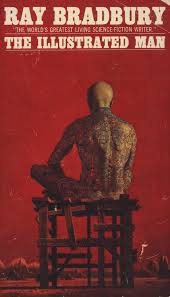 I mean, obviously, I've heard of Fahrenheit 451, I just haven't, you know... read it. But that doesn't mean I couldn't enjoy this month's book selection The Illustrated Man. Collections of short stories are almost always a hit at book club, because there's always enough variety that people find at least one story they connect with. This book was no exception- in fact, we unanimously liked the book!
The short stories in this book are all futuristic (though many take place in the 1980's or now-- they were all written in the 1950's) takes on technology and human nature. The stories either were about the end of the world through atomic warfare (something constantly present in the collective thoughts of the 1950's), or they were about a different life for people once space travel and "rocket men" were everywhere. While these specific events are not true of the future (at least yet) something Bradbury got right was the state of human nature. Bradbury captured the complexity of human character so perfectly-- while the potential for things like love and happiness exist in all of us, so do things like hate, fear, anger, and entitlement. Bradbury showed how consumerism and technology would be enough to corrupt us; while he was talking about rockets and not ipods, I'm not sure we are too far off his predictions of the world!
The short stories in this book were all tied together by the story of the illustrated man. This man was covered in magical tattoos that all moved and told stories, supposedly of the future. Each of the stories in the book was then supposedly one of the tattoos. I really liked this as a tool to tie the stories together. And in fact, the prologue and epilogue were some of my favorite parts of the whole collection! All in all, I thought this was a great book. After a fantastic discussion of this and Bradbury's other works, I may actually try to read Fahrenheit 451 one of these days!
*A final note. There are many editions of this book, and between the six people at our meeting, we had four different versions that didn't always include the same stories. Only one or two stories were different between the versions, but until we discovered that, our discussions were pretty bizarre (e.g., "You don't remember that story? But it was one of the best!)
everyone else in the world: "Oh, this book will be great! Fahrenheit 451 was so amazing, I bet this will be wonderful too."
me: ... *crickets chirping*... "yeah, totally."
The short stories in this book are all futuristic (though many take place in the 1980's or now-- they were all written in the 1950's) takes on technology and human nature. The stories either were about the end of the world through atomic warfare (something constantly present in the collective thoughts of the 1950's), or they were about a different life for people once space travel and "rocket men" were everywhere. While these specific events are not true of the future (at least yet) something Bradbury got right was the state of human nature. Bradbury captured the complexity of human character so perfectly-- while the potential for things like love and happiness exist in all of us, so do things like hate, fear, anger, and entitlement. Bradbury showed how consumerism and technology would be enough to corrupt us; while he was talking about rockets and not ipods, I'm not sure we are too far off his predictions of the world!
The short stories in this book were all tied together by the story of the illustrated man. This man was covered in magical tattoos that all moved and told stories, supposedly of the future. Each of the stories in the book was then supposedly one of the tattoos. I really liked this as a tool to tie the stories together. And in fact, the prologue and epilogue were some of my favorite parts of the whole collection! All in all, I thought this was a great book. After a fantastic discussion of this and Bradbury's other works, I may actually try to read Fahrenheit 451 one of these days!
*A final note. There are many editions of this book, and between the six people at our meeting, we had four different versions that didn't always include the same stories. Only one or two stories were different between the versions, but until we discovered that, our discussions were pretty bizarre (e.g., "You don't remember that story? But it was one of the best!)
How to Write a Lot
Since January, I have written my prospectus, two manuscripts, and statements for my job applications. And I have this book to thank for my progress: Paul Silvia's How to Write a Lot.
This little self-help book is specifically for academic writing, and even more specifically for psychologists (as Silvia is a faculty member at the University of Kansas in Personality Psychology). Silvia manages to take concepts that I "already know" and make them so blatantly clear that I can't get around them anymore. For examples, if you want to write a lot, you have to write often.
I'm waiting for you to pick your jaw up off the floor.... I know this piece of advice doesn't seem to groundbreaking, but for me, it was. Before reading this book, I survived as what Silvia refers to as a "binge writer". I saved up all my writing for big blocks of time where I would crank out a project in one sitting. I even did this in college for my written class assignments! While it was easier as an undergraduate when my blocks of time only needed to be big enough to throw together a five page reaction paper or article critique, now it is becoming more difficult. How am I supposed to find a chunk of time that is big enough to write say, a dissertation? Instead, Silvia suggests setting aside protected "writing time" two or three (or five) times a week. The rules of writing time? Write (doesn't have to be good, just get words on paper), read, edit, do some stats, format, save, delete-- basically, do any type of work on the writing project, keep track of what you did and how long you spent, and feel good about yourself when you're done.
Anyway, I cannot thank Silvia or this wonderful little book enough for changing my life. I now successfully have writing time at least twice a week and have become a much more productive graduate student. I think I'm going to re-read this book once a year to keep the inspiration and motivation fresh.
Til then, I have some more writing to do.
Thursday, July 5, 2012
Rory Gilmore's Bookshelf
Maybe it's because I'm always trying to come up with potential books to pick for book club, but when a good list of books comes up, I can't help myself but to read through it and see if anything strikes my fancy. Plus, I love a good "how many of these have I read?" challenge! The latest list I have found comes from Bust Magazine (a hip feminist mag I recently subscribed to), and happens to involve one of my most favorite TV shows, Gilmore Girls.
• My Sister’s Keeper by Jodi Picoult
• The Kite Runner by Khaled Hosseini
• The Namesake by Jhumpa Lahiri
• Reading Lolita in Tehran: A Memoir in Books by Azar Nafisi
• The Time Traveler’s Wife by Audrey Niffenegger
• Middlesex by Jeffrey Eugenides
• A Confederacy of Dunces by John Kennedy Toole
• Me Talk Pretty One Day by David Sedaris **I'm reading this right now! That counts, right?
• Life of Pi by Yann Martel
• The Red Tent by Anita Diamant
• The Secret Life of Bees by Sue Monk Kidd
• The Lovely Bones by Alice Sebold
• The Nanny Diaries by Emma McLaughlin and Nicola Kraus
• David Copperfield by Charles Dickens
• Little Women by Louisa May Alcott
• One Flew Over the Cuckoo’s Nest by Ken Kesey
• The Scarlet Letter by Nathaniel Hawthorne
• Hamlet by William Shakespeare
• Flowers for Algernon by Daniel Keyes
• Anne Frank: The Diary of a Young Girl by Anne Frank
• Uncle Tom’s Cabin by Harriet Beecher Stowe
• Of Mice and Men by John Steinbeck
• Sense and Sensibility by Jane Austen **I'm re-reading this right now for the first time since highschool!
• The Sun Also Rises by Ernest Hemingway
• The Great Gatsby by F. Scott Fitzgerald
• Jane Eyre by Charlotte Bronte
• The Metamorphosis by Franz Kafka
| It seems I'm not the only one interested in this idea. Check out this blog and this blog for more! |
While Rory Gilmore honestly always bugged me-- I mean, why did everyone think she was so amazing and perfect? Was she really that great?-- but I still can't help myself but to see how I stack up against her bookshelf. Below is the list of books that appeared in the series (c/o this Tumblr). A strike-through means I've read the book, and a highlight means I own it!
Finally tally-- I've read 28, and I own an additional three. There are some that I'm pretty embarrassed that I haven't read yet, so maybe this list will get me inspired!
• A Month Of Sundays by Julie Mars
• The Razor’s Edge by W. Somerset Maugham
• Small Island by Andrea Levy
• A Quiet Storm by Rachel Howzell Hall
• My Life in Orange by Tim Guest
• Truth & Beauty by Ann Patchett
• The Shadow of the Wind by Carlos Ruiz Zafon
• The Polysyllabic Spree by Nick Hornby
• How to Breathe Underwater by Julie Orringer
• The True and Outstanding Adventures of the Hunt Sisters by Elisabeth Robinson
• Nervous System by Jan Lars Jensen
• The Meaning of Consuelo by Judith Ortiz Cofer
• How the Light Gets In by M. J. Hyland
• Oracle Night by Paul Auster
• Quattrocento by James McKean
• The Opposite of Fate by Amy Tan
• Holidays on Ice by David Sedaris
• Sacred Time by Ursula Hegi
• Stiff: The Curious Lives of Human Cadavers by Mary Roach
• The Five People You Meet in Heaven by Mitch Albom
• The Fortress of Solitude by Jonathan Lethem
• Old School by Tobias Wolff
• The Curious Incident of the Dog in the Night-Time by Mark Haddon
• The Bielski Brothers by Peter Duff
• Brick Lane by Monica Ali
• Oryx and Crake by Margaret Atwood
• The Song of Names by Norman Lebrecht
• Property by Valerie Martin
• Rescuing Patty Hearst by Virginia Holman
• The Devil in the White City by Erik Larson
• Balzac and the Little Chinese Seamstress by Dai Sijie
• The Kitchen Boy by Robert Alexander
• Just a Couple of Days by Tony Vigorito
• Bee Season by Myla Goldberg
• Fat Land : How Americans Became the Fattest People in the World by Greg Critser
• Wicked: The Life and Times of the Wicked Witch of the West by Gregory Maguire
• Unless by Carol Shields
• Autobiography of a Face by Lucy Grealy
• When the Emperor Was Divine by Julie Otsuka
• Songbook by Nick Hornby
• Extravagance by Gary Krist
• Empire Falls by Richard Russo
• The Song Reader by Lisa Tucker
• Bel Canto by Ann Patchett
• The Amazing Adventures of Kavalier and Clay by Michael Chabon
• The God of Small Things by Arundhati Roy
• Ella Minnow Pea by Mark Dunn
• Seabiscuit: An American Legend by Laura Hillenbrand
• A Passage to India by E.M. Forster
• Frankenstein by Mary Shelley
• Ethan Frome by Edith Wharton
• Siddhartha by Hermann Hesse
• Speak, Memory by Vladimir Nabokov
• The Name of the Rose by Umberto Eco
• The Lottery: And Other Stories by Shirley Jackson
• Song of the Simple Truth: The Complete Poems of Julia De Burgos by Julia De Burgos
• Vanity Fair by William Makepeace Thackeray
• Fahrenheit 451 by Ray Bradbury
• The Picture Of Dorian Gray by Oscar Wilde
• Night by Elie Wiesel
• The Code of the Woosters by P. G. Wodehouse
• Complete Tales & Poems by Edgar Allan Poe
• Beloved by Toni Morrison
• A Tree Grows in Brooklyn by Betty Smith
• A Separate Peace by John Knowles
• Pygmalion by George Bernard Shaw
• The Story of My Life by Helen Keller
• The Awakening by Kate Chopin
• Time and Again by Jack Finney
• Brave New World by Aldous Huxley
• The Count of Monte Cristo by Alexandre Dumas
• Sybil by Flora Schreiber
• Dr. Jekyll and Mr. Hyde by Robert Louis Stevenson
• Cousin Bette by Honore De Balzac
• Heart of Darkness by Joseph Conrad
• Galapagos by Kurt Vonnegut
• The Master and Margarita by Mikhail Bulgakov
• The Jungle by Upton Sinclair
• The Hunchback of Notre Dame by Victor Hugo
• 1984 by George Orwell
• The Portable Dorothy Parker by Dorothy Parker
• An American Tragedy by Theodore Dreiser
• Death of a Salesman by Arthur Miller
• Crime and Punishment by Fyodor Dostoevsky
• Lord of the Flies by William Golding
• The Catcher in the Rye by J.D. Salinger
• The Bell Jar by Sylvia Plath
• The Sound and The Fury by William Faulkner
• The Adventures of Huckleberry Finn by Mark Twain
• Anna Karenina by Leo Tolstoy
• Emma by Jane Austen
• On The Road by Jack Kerouac
• The Fountainhead by Ayn Rand
Tuesday, July 3, 2012
Farm Anatomy
Julia Rothman's picture book Farm Anatomy: The Curious Parts and Pieces of Country Life provides the perfect escape to country life without the complications of quitting my job or moving. Rothman beautifully illustrates everything from tomato varieties to the appropriate methods of stacking firewood.
I gobbled this book up as a source of entertainment and retreat from reality, but I know that I will keep it and refer back to it as a resource. The book offers a deceptively large amount of information among its fabulous illustrations, and would help any farmer-wannabe get started with planting a garden, canning foods, or identifying a piglet from a shoat (guess you'll just have to buy the book if you want to find that out!)
Okay, back to gazing at the pretty pictures. I can't say I plan on planting an orchard any time soon, but a girl can dream, can't she?
Subscribe to:
Posts (Atom)